
Words for something you have long known
When I talk about the doshas for the first time, I often see people become attentive. Suddenly there are words for something they have long known in themselves: why one can no longer sleep under stress, another becomes heated and irritable, a third retreats into a leaden tiredness.
What was vague before suddenly has an order.
Three forces from five elements
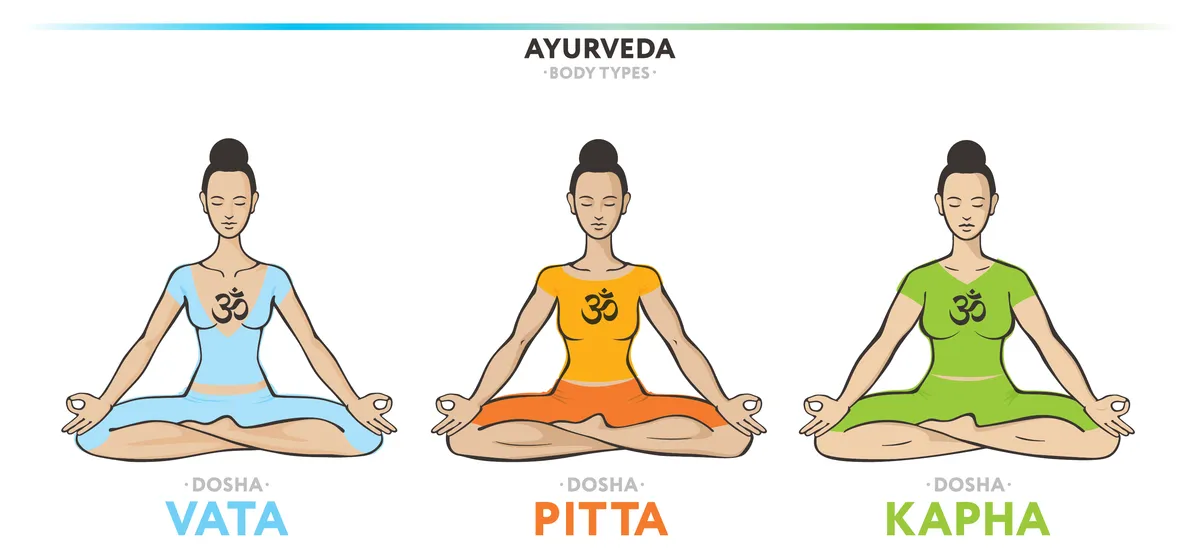
Ayurvedic teaching explains these differences with three fundamental forces, the doshas. According to this idea they arise from the five elements space, air, fire, water and earth and are at work in everything: in nature outside just as in us. A storm carries Vata, the midday heat Pitta, a calm, heavy mountain Kapha.
Every person carries all three doshas. It is not about fitting into a box. It is about the mixture that is our own. If you recognise yourself in several types as you read, that is no contradiction.
Vata: the principle of movement
Vata arises from air and space. It is the force of movement, the wind in us, as it were: sometimes a gentle breeze, sometimes a stirred-up storm.
People with a lot of Vata are always mentally on the move: curious, creative, full of ideas. They feel the cold more quickly than others and love warmth in every form. When Vata tips, through stress, overstimulation or too little sleep, liveliness turns into restlessness. Thoughts go round in circles.
Vata in balance: lively, creative, agile. Out of balance: restless, anxious, exhausted. According to Ayurvedic thinking, Vata needs warmth, rest and regularity.
Pitta: the principle of transformation
Pitta arises from fire and water. It is our inner fire. It gives clarity, drive and the courage to tackle things and see them through.
People with a lot of Pitta are focused, clear-thinking and structured. They like to take responsibility. But when the fire grows too large, it begins to burn rather than warm: determination becomes impatience, clarity becomes sharpness towards oneself and others.
Pitta in balance: clear, courageous, determined. Out of balance: heated, impatient, driven. Pitta needs cooling, breaks and permission not to be perfect. I have often seen how the strong women in particular, those who have everything under control at home, were allowed to learn during the cure simply to achieve nothing for once.
Kapha: the principle of stability
Kapha arises from earth and water. It is the calm, supporting ground in us, the force from which stamina grows.
People with a lot of Kapha radiate warmth and calm. They are patient, reliable and caring. Where others become hectic, they stay calm. In my travel groups it is often the Kapha people who, after a few days, hold everyone else together. When Kapha slips out of balance, the lovely calm becomes heaviness.
Kapha in balance: calm, steady, caring. Out of balance: sluggish, heavy, listless. Kapha needs stimulation, warmth and movement. Often it is a nudge from outside, a walk, a change of scene, a journey.
Most people are a mixture
We all carry all three doshas, in a very individual mixture. Ayurveda calls this basic mixture Prakriti. It is what we brought with us.
Through stress, poor sleep, a loss or years of overwork, the balance can shift. At some point you notice: I am no longer quite myself. Ayurveda calls this current state Vikriti.
Why a self-test is not enough
A woman who by nature has a lot of Kapha, that is calm, steadiness and grounding, can become restless after years under pressure and no longer feel settled anywhere. Someone who knows her only fleetingly might describe her as a Vata type. The experienced doctor sees it differently: he recognises the original nature beneath the exhaustion.
That is why every cure begins with a detailed conversation. The doctor listens, feels your pulse and puts together a personal plan from that.

A tradition, not a diagnosis
The doshas are a traditional explanatory model of Ayurveda. They are not a medical diagnosis in the sense of Western medicine and do not replace medical advice. If symptoms are weighing on you, please talk to your doctor.
What moves me about this model: it is about understanding you. You are not your symptom. I say more about this in chapter 2 of my book “Ayurveda erleben”.